- Burroughs Adding Machine Repair
- Antique Burroughs Adding Machine Repair
- Burroughs Adding Machine Repair
Mechanical Calculators
Cleaning Office Machines with 'LIX'
| From: Ernie Jorgenson Subject: Cleaning Office Machines with 'LIX' Date: Saturday, December 27, 1997 8:58 PM (Updated April 23, 1999). Well a little more on cleaning mechanical calculators and adding machines. We have found and purchased several gallons of 'LIX.' LIX is the cleaner that most office machine companies used to chemically clean typewriters. adding machines, calculators, check protectors, nearly any mechanical office machines. Here is the process: 1. Mix 1 part Lix with 7 parts petroleum solvent. Soak your machine in this solution for an hour or more depending on how dirty and gummy it is. 2. Wash machine with hot water and blow dry with compressed air. Don't blow your springs and 'stuff' off. 3. Spray the machine with a very light oil and let it dip dry for several hours. Be sure you remove all motors, electrical wiring etc., before cleaning machine. LIX can be used over and over, when you are through cleaning machine, just store in an air tight container for the next machine. Collectors can purchase LIX by the gallon directly from LCS Corporation QUESTIONS: <ejorgens@lewiston.com> |
| From: Nicholas Bodley Subject: Cleaning Office Machines with 'LIX' Date: Sunday, December 28, 1997 Priceless information! This information that Ernie supplied was something I long ago knew about, and had also forgotten the details of, long ago. For anyone who's considering restoring (or even using) an old mechanical calc, adder, or typewriter, this information is almost priceless. I watched Friden mechanical calcs being cleaned in the shop, and Friden more than likely also used LIX. It was most impressive to see a machine come out of the cleaning bath! It had a peculiar sheen, and there wasn't any grunge at all. (Wonder about ultrasonic cleaning.. DO ask the manufacturer of the cleaner before using such a solution as this!} Do remove any electrical parts; some old paints, and rubber rollers (such as Flexowriter and other power rolls, and adder and typewriter platens) might also be vulnerable. Friden used compressed-air operated baskets and washtub-like vats for cleaning machines. The air cylinder would lift a wire basket to a convenient working height; the technician would place the partially-stripped machine onto the basket, and then operate a valve to lower the machine into the solution. The air would raise and lower the machine, swishing the solution through it. If someone would offer a machine-cleaning service, I suspect there would be a fair bit of business. I do hope everybody knows how to pack a calc! A mechanical calc. that has been damaged in shipping is Cause For Great Sadness! Does anyone know the chemical composition of LIX, even in a general way? Is it still being manufactured, or at least, if Ernie's stock runs out, is there more available? (I'm all for buying through Ernie!) It's a not-really-wild guess, but I'll bet that a lot of locked-up calcs have quite-gummy lubricant, and really need this type of cleaning. Anyone contemplating calc. work should get in touch with typewriter repair people. They are rather close cousins, who use many of the same tools. There's my $.15 worth. My best to all, with wishes for a bright and shiny New Year! May all your calcs give the correct answers to all-nines squared. |
| From: Frank Lindauer Subject: Cleaning Office Machines with 'LIX' Date: Monday, December 29, 1997 To the List: I have enjoyed Ernie Jorgenson's and others comments on the use of LIX almost as much as the discussion of the use of WD40 (not really!). I've used LIX in an automotive parts washer with little more success than using straight mineral spirits, but I think I now know why. The parts washer has no real pressure at the nozzle and does little more than dribble the solution on the machine. An office machine in a small parts washer is awkward to handle at best. I guess immersion in the solution in a large enough container is more effective. I had also missed the hot water final rinse. All these treatments assume a large container and very hot water which can make for a messy area (not the kitchen, for sure). I have an air compressor in my garage and can handle that part of the treatment. I would hate to ruin a good paint finish, but I don't think LIX and mineral spirits will do that. If anyone can suggest some tips on handling the problems I've mentioned, please let me hear from you. |
| From: Don Bryant Subject: Use Very Hot Water w/Lix Date: Sunday, December 29, 1997 9:39 PM I used to use Lix to clean office machine many years ago, (1956-1975). The very important thing to do is use Very hot water to clean off the LIX solvent. Hot enough that the machine will dry from the heat. I would be very careful about leaving key top and painted parts in the solvent over a few minutes. I use to prefer spraying the solvent with an air gun. Note that vapor is harmful..soaking is safer health wise. Rust spots and dry pockets were the disadvantage of using this product. However it is one of the best cleaner available. We did not have spray cans of oil & lubricants. We would mix 2 qts. of 10 w non det. oil in a 10 gallon vat. of mineral sprits and soak it after drying. On very close tolerance machine like the Remington 96-99, we would use Winns Friction Proofing. I hope this extra 2 cents worth is helpful.. |
| From: Nicholas Bodley Subject: Discussion of 'LIX' Date: January 1, 1998 On Mon, 29 Dec 1997, Frank & Karen Lindauer wrote: '.. awkward to handle at best. I guess immersion in the solution in a large enough container is more effective.' At the Friden NYC office in 1962 or so, I saw a washer (very likely listed in the Ames Supply catalog of the time, and conceivably still available) that immersed one calculator (minus covers and electrical items) in a vat of what must have been LIX and solvent. It used a vertical compressed-air cylinder fed by an air-pressure-cycling system to move a welded-wire basket (perhaps just a wire shelf), holding the mechanism, rather gently up and down in the solution. I'm just about sure these washers were standard equipment in thousands of calc. and typewriter-repair shops throughout the USA. By all means, see Ernie's message about the full procedure! |
| From: Mike Hancock Subject: The way I remember it at Burroughs Date: January 2, 1998 Regarding cleaning and oil. At Burroughs Adding Machine Company we used something called Tulles or Tullus oil. It was a light oil, very clear. I think it was purchased at that time from Union 76. As far as cleaning the machines we would soak them in a solvent tank. Again, it was the kind of solvent that you could purchase in local gas stations at the time although we ordered it in 50 gal. drums for our shop. Soaking a machine was a last resort as it was very hard on the main bearings and the machine had to be very carefully oiled afterward. The adders rarely needed this type of cleaning but the key driven calcs were a frequent visitor to the solvent tanks. All of the mechanisms rode on shafts and the oil would gum up under these parts causing more an more difficulty as time went on. The worst thing was that we would adjust the unit as it began to get sticky and when you did clean it you ran a risk of having to go back and make a bunch of re-adjustments. In any case, many time the shafts had to be completely pulled and all parts washed in solvent. Anyone who has worked on a Burroughs Key Driven calc would understand that you did not take that step lightly. The reassembly took several hours if you had the skill. Burroughs also had a chlorinated solvent called Platen Restorer which we sold in small bottles for cleaning platens. We would use this nasty little chemical to soak parts as well although you had to be careful as it would damage some materials. I am going to look back at some old tool catalogues and see if I can get a better description of the oils and cleaners we used at the time. Igi 1 game apk download for android apk. Jump into best action strategy game with top fps shooting infiltration missions with griping storyline. Your mission in this free online action shooting fps game is to infiltrate enemy base and survive attacks from terrorist soldiers.Are you ready? You are a one man sniper army. Use more than just your sniper rifle gun to clear enemy base as each shot will alert enemy shooters.Become a part of a thrilling challenge of gun battles and assassinations in this top free online action shooter game. Also, anyone who needs spring hooks, both push and pull, I have a bunch. The very same as the ones that were used to fix the old adders at Burroughs. If you were removing springs you absolutely needed a set of spring hooks. I wish I could show you all how we held a push and a pull together to install a spring way down inside a machine. If anyone is interested let me know and we can figure out a price. |
| From: Nicholas Bodley Subject: The way I remember it at Burroughs Date: January 2, 1998 Michael, it was good to hear from you. Some of us on the List (not me/I, yet!) need this information. As to that oil, maybe Tellus? Industrial lubricants seem to have distinctive names, almost as prescription drugs do. I'd like to get a couple of spring hooks. Some of the electronics-industry tool houses (who also sell solder and flux, as well as specialty chemicals) are good sources for small hand tools. |
| From: Skip Godfrey Subject: Cleaning Office Machines with 'LIX' Date: January 3, 1998 Hello all - I've been following all the discussion since Ernie mentioned the availability of LIX. When I saw mention of Wynn's (Wynn's Friction Proofing), it rang another bell. When I started tinkering with cars, bbd (back before dirt), Wynn's and Shaler's Rislone were the two most common oil additives that I knew of. I use Rislone in my car - it's available in two formulations: 1 is a 1-quart size which is part standard oil and replaces 1 quart with an oil change; the other is a 1-pint size which is added after an oil change (that's what I use since I don't change my own oil). I don't know the pros and cons of using it - ? ? ? Nicholas ? ? ? |
| From: Skip Godfrey Subject: Cleaning Office Machines with 'LIX' Date: January 19, 1998 Hello all - I've meant to join the growing discussion about oils and mention jojoba oil. Several people, including Frank Lindauer, commented about it to me. I've been aware of it for years but only in the context of its use in cosmetics, as a 'hair restorative b/4 Minoxidil', etc. Frank, I believe, mentioned that a Cadillac mechanic mentioned it years ago as the best thing to use in transmissions (automatics, I'm sure). It is supposed to be a direct equivalent to whale oil but acceptable nowadays because it's pressed from seeds. I located a source in 3.4 ounce bottles which run about $20 with shipping. If anyone is interested in experimenting with it, please let me know and I'll send you the address. I ordered some and plan to see what it is like. |
| From: Ernie Jorgenson Subject: INFORMATION FROM THE LIX LABEL. Date: January 19, 1998 FOR WHAT IS WORTH THESE ARE THE INSTRUCTION FROM THE LABLE ON THE 'LIX' CAN. OFFICE MACHINE CLEANER MIXING INSTRUCTIONS For Still Cleaning: Pour one gallon of Lix #12A Concentrate into 6 gallons of Stoddard Solvent. For Spray Type Cleaning Machines: Lix #12A may be diluted as much as 12 to 1. DIRECTIONS FOR USING Strip the machine in the usual manner (remove platen, feed rolls etc) Submerge machine in....or spray on.. the prepared solution. Allow 3 to 15 minutes or longer if desired for cleaning. Remove from Lix and rinse in hot water or spray machine with...or submerge in...a clear mineral solvent. Lubricate according to your established practice. CAUTION -Do Not Agitate with air. -Do not take internally. -Do not use in a copper tank. -Wash thoroughly after handling -Avoid contact with eyes, skin and clothing. -Avoid prolonged or repeated breathing. -Wear goggles or face shield, rubber gloves and protective clothing when handling. |
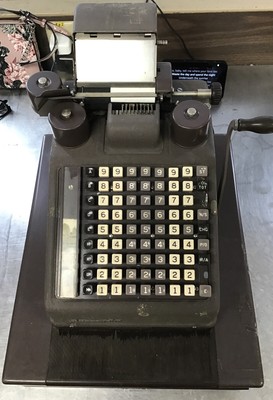
I have a Burroughs adding machine serial number 5-1332940 in working order. I was wondering if you knew the age and how much it would be worth and if you knew any one that would be interested in buying it. Michael, 10 years ago the small crank handle is beveled. The adding machine also has its own original leather case; BHenry, 10 years ago. I need the instructions manual/repair guide for a Burroughs adding machine. Where can I find one? This machine has 9 rows x 9 columns keys, very,very heavy, and have a little glass window that shows the totals.
Looking for Antique Adding Machine? We have the best deals on Antique Adding Machine so stop by and check us out first! Antique Burroughs Adding Machine No 3. From the first adding machine to today’s most complex cash automation, we’ve seen and helped drive numerous evolutions in payment and transaction technology. Our team has the expertise and progressive thinking to help guide you through decisions to ensure the best outcomes.
X-Number World
- Jukebox repair in Redding, California at AmericanListed.com – Classifieds across California. A wide variety of classified ads Buy, rent, sell and find anything - jukebox repair listings.
- The Starr Adding Machine by the Todd Check Protectograph Company of Rochester, New York and manufactured in 1921. This machine has been fully and beautifully restored and has a condition rating of 1,1. If you are looking for the best surviving speciman of this particular adding machine, you have just found it.
- I joined Burroughs pre Decimalisation, in 1969, working for Bristol Branch in the UK, The service manager was Bernard Parsons, two of the Zone managers were Wilf Parkhouse and Roger Rumble, and I spent a number of months living in a bed-sit in Bristol while doing initial training, on things like the P6000 cheque encoder (horrible machine), the.
Revised: June 21, 2004.
Memories of Burroughs
These (edited) memories have been contributed by visitors to this web site.Subject: Series L/TC - From: Henry Griggs of Virginia, USA J2 prime unlock code free.
Wow. All those photos! They really brought back the memories of the Burroughsgear. I liked the L series of machines, but the B80 was my favourite. I did alot of work on those things, but only the really cut down ones, not the reallyfast ones.
I've got a bit of Burroughs memorabilia stuffed away - the little yellowAssembler code notebook, notepads with Burroughs logos, some advertisingmaterial.. I'll scan what I've got and send the images to you so you canenjoy them too. I might scan that entire little assembler coding book. I spentso much time with it, it was years before I could forgot those codes!
Subject: B700 - From: Bill Roberts of New York State, USA
I worked for Burroughs in Downingtown, PA, from 1972 to 1977. We made theB700 and B800's there. I wrote the micro-code that allowed the B700 to doaddition and subtraction (in decimal so there were no binary rounding errors). Ialso headed up a team to add up to four key-to-disk microprocessor-controlled(B7* microprocessor) keyboards to allow key-to-disk data collection andverification while the B700 continued it's normal processing.
The key-to-disk system was the AE500 system. This system was being developedwith all the following going on at once: modification of the disk controlhardware to allow control by both computers (B700 and B7*) at the same time;development of the Assembler to do the micro code for the B7*; development of aninterpreter to read the audit entry instructions; development of a compiler tocompile the AUDit EntRY (ADURY, the official name of the compiler) instructionsto something that could be interpreted; and modifications to the micro code ofthe B700 to allow for multiple disk accesses. The only debug tool was anHP logic analyzer with 8 probes!
I remember hooking up the TD700's (terminal display units) to the B700.
The B700 was originally released with RPG-III. Although I wasn't involvedwith the development of that system, I did decide to learn the language, andwrote a program to keep track of my personal finances for (US) income taxes.This helped to uncover some early bugs in the compiler, and, as a result, mypersonal finances ended up as a part of the test suite for the B700! I at leastgot to change some of the numbers before it got out of the plant and on to oursales forces in Detroit.
We intended the B700 to compete with the IBM System 3 (also an RPG-IIImachine), with the B1700 as the 'big brother' for when the customerneeded a faster machine. As a result, we were one of the first purchasers of theIBM System 3, a fact IBM made use of in its sales promotions. Well, we neededsomething to run our tests on! In both compile time and program run speed, wewere able to beat the System 3. But the real problem was that we totally wipedout the B1700 as well! Turns out the B1700 disk-swapping system swapped out thedisk controller at every opportunity, and that had a negative effect onperformance. Burroughs management was not amused, several engineers at the B1700plant did not get their Christmas bonuses that year, and there was a lot of hardfeeling between plants for a while.
We took pride in creating demo's that really did stress the machines as muchas real life applications. But remember, we were the developers, and quite oftendid not realize how the machines would really be used.
Finally, I did the design on the B800 job-swapping system. I left before thatproject came to fruition, but it was a fun project. If you ever played the'Battleship' game on the B700, I did the firing algorithm. It wasquite a machine, and (IMHO) well ahead of it's time.
Subject: Burroughs and SAM Systems - From: MikePiper, Menai Bridge, Anglesey, United Kingdom
Talking of Altham's Travel, I took over the majority of the programming workfor them from Brian Fairies (a colleague at SAM's) in 1982, who'd written theoriginal batch processing travel agents system, which SAM's also sold to StarTravel. I converted the system to real-time and added various new features, suchas BACS output for ticket payments and an airport transfer system to providetransport scheduling to and from Manchester Airport. All this work was specifiedby Altham's financial accountant, David Ball who might still be working there -I spoke to him about 5 or 6 years ago. Apparently they moved to IBM AS/400equipment in the early 1990s.
Stollers is another company I did programming work for. By then, they had aB80 running a modified KeyBMS accounts receivable system. I went there a coupleof times with Martin Harbour (of SAM's, also an ex-Burroughs guy - Stockportoffice I think) to install extra sales analysis tailored for their furniture business.
I used both the SL3 and SL5 languages on the L series machines, L2000, L3000,L6000, L8000 and L9000 - also the TC500 comms-capable machine, up until around1980. After that I used Cobol and MPLII for the CMS machines (B80/90, B800/900,B1800/1900) up until 1992. MPLII was used mainly for the on-line applications,to write tasks (sub-programs) that slotted in to Burroughs Proteus skeletonapplication (written for them by Cap Systems, based in Leeds) which communicatedwith TD830 screens.
Cobol was best suited for the reporting functions.
When I talk to people about Burroughs equipment, I usually receive a blankexpression. It always surprises me that Burroughs weren't more well-known, andas you say they were the world's second largest computer company at one point.
Subject:Memories from Tom LaPorte
Iworked in Downingtown, Penn for about 6 months in about 1975 or 76. It’sall a bit hazy now and I would really like to hear from someone who could fillin some of the gaps in my memory.
Istated with BBM in Canada but was transferred to Downingtown as part of aproject team applying the CMS operating system from the B80 to the new B800. The B80 was a single operator system and on the B800 we had to develop a wholenew operator interface to allow multiple applications to be shared by multipleoperators, one at the console and others on terminals (maybe TD800’s??). This sounds really basic now but I believe that we had the very first multi-usermulti-application operating system on pretty much any business computer smallerthan corporate mainframes. I had completely forgotten this but when I readBill Roberts’ comment on your Memories of Burroughs page I remembered workingon Battleships. I remember that someone else in the team had written theentire core of the program which tracked the shots taken and their effect on theship targets, I suppose that was Bill as he says, and I wrote the operatorinterface (the entry of the shots taken and the reporting of their effects) so Iwrote the small user piece and demonstrated it to all the BBM brass along with avery basic Accounting Simulator application which I wrote for the systemslaunch. It was basically just a series of screen images which made it looklike Accounts Receivable, Accounts Payable and General Ledger were all runningsimultaneously but really it was just a series of images which the salesmen hadto follow to show the system’s potential. I remember that the B800 wasshipped more as a developer’s platform than as an user product as there wereabsolutely no applications written for it. We had planned to develop somemore impressive demonstration programs for it but there was pressure on tolaunch the system so it went out with only the Accounting Simulator andBattleships which could be demonstrated on it.
Ialso remember that we had worked on prototype systems and when the engineersrolled out the shipping system it did not have the PF keys across the top whichthe old B700 keyboard on the prototypes had. Unfortunately my demoprograms used the PF keys for input and so they didn’t work. This wasabout two days before the launch. The engineers argued that the systemdidn’t need Program Function keys any more as they weren’t program specificand so couldn’t be mapped to specific functions in a multi-userenvironment. Unfortunately there wasn’t enough time to change my demoprograms and all the shipping documentation so they had to put the keys back inby the launch. We compromised by having them label them F keys (F1 thru F8I think) rather than PF keys. As we went to market first, when the IBMsystems launched they also had the F keys on their keyboards although theydidn’t use them for anything in their initial demo systems. Easy recovery pro serial key generator. I rememberhow excited they were at Head Office that IBM was following their applicationmodel. I don’t know, does that mean that I invented the F keys? They are still around and they still hardly ever do anything for most users.
Thesememories are very hazy. I would really like to have someone who knows moreabout computing history who could comment on the implications of our project atDowningtown. I seem to remember that we beat IBM to that market by amatter of several months.
Afterthe B800 shipped I was transferred to the head office in Detroit where I sat ata desk and was the contact person for every branch around the world who had justreceived the new B800 systems. The most common question they asked waswhat were they supposed to do with these systems as they didn’t do anythingyet. I think the first shipping year was very slow.
WhileI was on the phone, the guy at the next desk, Mike Hughes, was setting up aproject team for a huge sale of B800’s to SWIFT (from memory, the Society forthe Worldwide Interchange of Financial Transactions). One day he asked meout for coffee and invited me to join his project team as he had overheard a fewof my telephone conversations and that I knew more about application developmenton the CMS platform on the B800’s than anyone else he was able to find for theproject. That was based on my development of the Accounting Simulator andthe Battleships operator interface but it probably was true. I acceptedand was transferred to the SWIFT Project Office in Brussels, Belgium where ourteam wrote a switch which transferred large amounts of money between variousbanks in 11 countries. Our team was headed up by Mike and had members fromJapan (Yutaka and Kazuo), England (Ray), US (Chris), Greece (Niki), Holland (twobut I can’t remember their names) and myself from Canada. Perhaps one ortwo more that I can’t recall right now. The development took well over ayear and grew into a much larger application than had even been plannedinitially. It became much too big to test and playing computer with thecode was very hard as it was all being done in very low level language. Ican’t remember what that was now. I wrote a filter which inserted trappoints at every conditional statement and at the entry and every exit from everysubroutine. On execution you could programmatically turn the traps on andoff in order to debug specific sections of the massive program. When itfinally shipped, Chris and I toured the system to all the 11 countries where thesystem was installed. For a few months afterwards we provided systemsupport for the systems which often involved flying there to help them out. I believe we made about a 100 flights in and out of those 11 countries over thenext 3 months. Often two or three countries in the same day.
Afterthat I was assigned to the NatWest Bank in London for about 3 months and to theBurroughs plant in Cumbernauld, Scotland for another 3 or 4 months. I thenreceived an offer from Burroughs Denmark to work there on their CMS sales and asI had quite a few friends there I requested a transfer to Copenhagen but theComptroller back in Brussels, who didn’t know that I had received an offerfrom there, lied to me and told me that he had contacted the office in Denmarkbut they didn’t have a position for me but if I did a certain assignment thathe needed me for in Belgium, not a very good offer financially, he was sure thatDenmark would be interested in me after that. So I got my nose completelyout of joint and quit Burroughs. I still have my reference letter fromMike at the end of that project including an apology for the Comptroller’sactions and his regret that I had been treated that way. Mike was a classact but the Comptroller, Roland, was a real piece of work. I went back toWinnipeg, Canada and worked on CMS systems and then Windows Servers until Iretired a few years ago.
Subject: Memories from Fred Little,Preston Branch
Doyou remember me..Fred Little?
Iwas a field engineer.
JimCassidy was the Service manager who took me on..he’s 2nd from the left (nextto Brian Dugdale) in the Elliot Rae retirement do which i don’t rememberattending.On the extreme left isHarry Oldroyd. He was a field Hngineer from Lancaster. He spent a lot of time at‘Storey’s’ and Lunesdale Farmers.
Iremember Ken (leave it to me) Tipper too !
Whatabout Ron Berrington too..He was on EDP as engineer on the B500 at BurtonsBiscuits. He emigrated to New Zealand.
Iwas for-ever going to Dockers of Barrow (Mrs Fitzjohn!) to sort out their F5000dual printer which broke down all the time because the program was too much forit!
Iworked on the E2000’s too. I well remember blowing-up W & J Pye’s oneday when I disconnected a very big multi-pin connector with the mains still connected. I effectively put 240Volts AC on a –4 volt line and took outabout 20 boards! But that's how you learn!Ofcourse no-one knew what I had done at the time..all part of being an engineer!I learned a hell of a lot about the E2000 whilst getting it workingagain!
Thenthere was the E4000 at Lancaster Town Hall which I worked on but never did thefull course for!I always rememberthere was an intermittent fault there. All our brains were on it for weeks. Theyeven put in a special mains supply but it still miss operated! Thecustomer was at 10,000ft!
Oneday a scruffy chap called Keith Grand-Scrutton turned up from Head Office.He got no tools out or equipment..He looked at the print out where ithad gone wrong. He looked atthe ‘program’,After about 20minutes he uttered the immortal words ‘Change Memory Driver Card B’.Of course we didn't have one but one was acquired and fitted. Themachine NEVER failed again..at least not for that fault.What an ego killer! Non of the so-called experts had even given theMemory Driver Card B a thought!
Ialso worked on the banks TC500’s (boring as you became a part swapper) andmore interestingly the early ATMs..£10 a day jobs! How times have changed injust a few years.
Therewas a lovely girl called Trudi in the front office and we had a‘demonstrator’ by the name of Jan Warbrick.I remember in the early days Pat Gormley couldn’t drive and wenteverywhere by bus, as a service engineer!
Morecustomers I visited were ..Provincial Insurance in Kendal (F1000 I remember itwell). Mansegh’s in Lancaster (E2000) ... Kelmac at Carnforth (E1000)..Omeridear Earby (E2000 gave little trouble!)….Leonard Fairclough at Adlington (E2000s).. Goss’s Preston (F1000 & E1400.nightmare!) .. Ashley Accessoriesat Ulverston (E2000).. Althams Travel at Burnley (E1400)..Atwater Preston(F1000).. Evening Gazette Blackpool (E1000).. Lune Metal Spinning at Morecambe(E1000).
Iremember going to Midland Bank Accrington one Monday morning in response totheir ATM having shut down. There was a £10 clip sticking out which anyonecould have taken and it had been there since Friday when the machine powereditself down because it had sensed the jammed clip! ie, theclip hade to be removed within a certain time limit. Someonehad used their card and forgotten to take the cash!I wonder if that would be the case today?
Ialso worked on the punched tape kit. Before Nat West Bank went over to TC310’sthey had Burroughs punched tape for a year or two. At the end of the day thetapes were loaded onto a Plessey on-line reader which transmitted the data tothe mainframe at Bootle..if they were lucky!So we had a mechanical accounting machine (SeriesF) connected to thepunch tape unit which was all relays and stepper switches! What a mine field! Itwas a miracle it worked at all!
Gta vice city apk download for android free highly compressed. Download Grand Theft Auto: Vice City Highly Compressed 233MB About game. Genre: action adventure video game supported by open play. Platforms: PlayStation 2; Microsoft Windows; Xbox; Mac OS X; iOS; Android; Fire OS; About the game. Grand Theft Auto: Vice City Highly Compressed or GTA Vice City is an action-adventure game. It was developed in 2002. GTA Vice City APK + OBB DATA Highly Compressed (199MB) for Android - Hallo friend JUST FOR KIDS, In the article you read this time with the title GTA Vice City APK + OBB DATA Highly Compressed (199MB) for Android, we have prepared well for this article you read and download the information therein. Hopefully fill posts Article ANIMATION, Article EDUCATION, Article FILM CHILDREN, Article GAME.
Thethere were the ABC machines around decimalisation time..Already been Converted.What a disaster they were..The ideawas that the user could flip from sterling to decimal and back. After D-day wejammed them all in decimal mode!
Imet and married Dot Bradley who worked in the front office with MarjorieCrowther in charge.Laurie Taylorwas my best Man.

Muchthough I enjoyed working at Burroughs, ‘they’ thought that was sufficientreward and paid their engineers poorly.Theydidn’t pay me enough to live to a decent standard as an engineer so I had toleave.I joined Lansing Bagnall as aservice engineer.What I change fromoffice to boiler suit!But they werea good firm, paid very well, gave you a vehicle and very had good training.
Ihave to say that my electronics training (TPC’s) at Burroughs have alwaysstood me in good stead. Technology advances but the basic principles stay thesame.I ended up training engineersat Lansing after working there for several years. (You had to have at least 6years experience in order to apply for the technical jobs).
Youwill appreciate that some of the modern warehouse equipment has quitesophisticated electronics which has to survive the rigours of the machinesmovement. So as with everything there is more to materials handling equipmentthan meets the eye.Linde (ofGermany) took Lansing over in the early ‘90’s and things became a littleuncertain but we came through it fairly unscathed.
Iended up as electric products technician for ‘Linde Sterling’ who werethe distributers for Linde in the NW.Aswell as trouble shooting I was also responsible for training service engineers.I was always in the happy position of knowing more than the management(at least on the tech side..which was all that I was interested in) so I ‘didmy own thing’ most of the time and got quite well paid for it too!I never wanted to be a ‘manager’..whatever that may mean. I wantedpeople to come towards me when they saw me ..not walk away!
SoI had a great 36 or so years in the materials handling world.I retired in 2009 (a bit early) and haven’t missed it one bit!
I'vebeen with Longridge Band (where I live) for almost 30 years and being Secretarykeeps me occupied.We take our 2lovely granddaughters to school EVERY day, which makes us get out of bed!I’m a keen photographer (got my LRPS after retiring ) so that takes uplots of time too.
Justremembered another couple of things...Brian Compstey, Alvar Rodger, BurnleyBuilding Soc.. Preston Farmers..and Heysham Harbour.. well her chest ! (andshe knew it..I was only early 20’s)There were some perks!
Ithink that’s enough for now..I could go on.
Subject: ’Too far ahead of its time’: Britain,Burroughs and realtime banking in the 1960s
Subject: Memories from Judith Weekes, Machine Operator in Burroughs Australia from the 1950s
I worked for Burroughs Sydney based in 1950's.
I am now 81 years of age but have fond memories of what was considered a skilled position to hold.
I began operating a manual comptometer then a Duplex comptometer. It was such joy to operate, after the manual comptometer.
Then I progressed to the bookkeeping machine to do payrolls. I think the model of the bookkeeping machine was a number 78
The next machine I operated was a costing machine purchased for the costing department.
From memory I think it was called a multiplier.
My hands and fingers now are showing the wear and tear caused by the strength needed to operate the mechanical machines.
Despite this I have no regrets.
They were actually the precursor to the computer which is now the modern machine.
I now use a computer which is the modern miracle machine and moving forward at a fast rate.
I'm sending this as my record of nostalgia thinking back so so long ago.
I worked on an L5000 series at H.G. Usher in Edinburgh in 1972-74 after leavingEdinburgh University with a very average BSc in Biological Science.In those days you could sit an 'intelligence test' to see if you were suitable for programming. HarryUsher ran one of the first software companies in Edinburgh. I developed in Assembler or machinecode for efficiency and I still have a copy of the code book somewhere and paper tape program. Sometimes had to patch a bad bit of parity using the hand-punched overlay tape. Using mag stripe ledger cards for accounting systems. Later H.G. Usher got a COBOL compiler. I left for Australia to start work in COBOL, strangely enough for a finance company (General Credits) with a Burroughs B4700 using punch cards (1 compile per day and lots of desk checking).
Burroughs Adding Machine Repair
Started with Burroughs in Binghamton, NY at the ripe old age of seventeen in 1966. I guess I must have done okay as it was off to Detroit for Sensimatic training in January of 1967. Then the 'Even E's' in late 1969 followed by the L's and TC's pretty much from start to finish. I left Burroughs in 1979 to go with FourPhase Systems. Three years later some former Burroughs guys and I got together to do what Burroughs was trying not to do.. we took over the 'L' business in southern NY.
Training? As others have stated.. very good!
Pay? It depends on your perspective. I wasn't getting rich but Burroughs was by no means terrible.
And then the experience. Put training and pay aside if you will.
Burroughs exposed me to things I'd otherwise never have known about.
Burroughs also allowed me to meet some powerful and influential people.
People who would prove invaluable to me over the years.
I joined Burroughs Field Service in 1958 on demob from RAF/National Service, working out of Northdown Street, Kings Cross. London West-End Branch transferred premises to Baker Street, LondonW1. Branch Service Manager was George Breed, then Andy McCulloch, who promoted me to Zone Service Manager. I was with Burroughs for 10 years, then moved into a full sales position with H.J.Heinz 57. I don’t expect any of you guys to know me, but I’ve been trying to make contact with anybody who remembers Sensimatics, etc, for ages. I hope I’m not barking up the wrong tree, and look forward to hearing from any of you.
Subject: Memories from Steve Garry of Burroughs in Bristol area
Been reading through some of the Burroughs site memories - it's probably time for me to add a bit to the mix.
I joined Burroughs pre Decimalisation, in 1969, working for Bristol Branch in the UK,The service manager was Bernard Parsons, two of the Zone managers were Wilf Parkhouse and Roger Rumble, and I spent a number of months living in a bed-sit in Bristol while doing initial training, on things like the P6000 cheque encoder (horrible machine), the J series adding machine, and then the TC500 which was being installed in massive numbers across the Midland Bank, National Westminster Bank and Barclays Bank branches in the run-up to decimalisation.Due to the timing, I never got involved with the older mechanical and electro-mechanical accounting systems, although there were quite a few around the place
I had my own car, which was unusual in those times, so quite often I was the driver for an experienced engineer who didn't have his own transport, but it meant that I got to see and experience a lot more than some of the other trainees at the time.There were massive numbers recruited around then due to the huge bank order for TC500s, which in most cases were on 4 hour response-time maintenance contracts, which was a problem in the rural areas due to the distances involved.It would be nothing for me to claim 600 or 700 miles a week of travelling, and that was without a 180 mile round trip to the branch office from home, and this was in the days before the motorways, so getting home on a Friday evening in the summer could take 3 to 4 hours due to the volume of traffic on the roads. I think the highest I ever claimed was 1,200 miles in one week, but that was dealing with a major system crash on a B700 system that was a long way away from me, and in those days, the company didn't do things like pay overnight hotel accommodation, which would have been more cost- and time-effective, given how slow the B700 COBOL compiler was (8 cards a minute if I remember correctly, so a small program took a number of hours to compile, and if there was an error, you didn't get to know about it until the last pass, which could be incredibly frustrating).
When I started, home was not in the Bristol Branch area, but it was agreed that I would operate from home, which was Exeter, as the Bristol branch covered Somerset and Dorset, and I could get to both from Exeter relatively easily.In those days quite a few of the engineers didn't have their own cars, but I did, so being able to cover a large rural area was a huge advantage.The he down-side was that I could go for days without seeing another engineer, and I had to be very much self sufficient in spares in order to meet the response times that had been agreed with the banks.So, the car ended up carrying a considerable load in spares weight, especially when the L8000 & L9000 series came on stream, due to the different circuit boards on those systems.
In 1971 we moved to Wellington in Somerset when I got married, which meant I was in the branch area, and I spent the next 5 years working in Somerset and Dorset with occasional trips to other areas depending on the urgency of the calls and availability of an engineer to respond.Bristol covered a huge area, from Minehead in West Somerset to Blandford Forum in Dorset, and up to Moreton In March in Gloucestershire, then across to Swindon, down to Devizes, and then down to the South Coast.Pre-motorways, it could take 2 or 3 hours to get to one call, and I could easily do over 200 miles in a day if someone was out sick or on holiday.
In the early days of the TC500 there were no parts vans to deliver things like print-head decoders to us, so if a decoder failed, which they did regularly due to some design issues in the print head that were not found for a while, it was a case of doing an on-site rebuild of the decoder.That was a big job to do, and sometimes messy if the oil seals were bad, so there was oil everywhere inside the machine. Sometime later a central rework facility for decoders was set up, and (Securicor I think) a van service to deliver parts was introduced to make it easier to meet response times.So the engineering skills needed to repair the machines was significantly diminished, most repairs were a major module swap - good from the bank perspective, but not good for the engineers who joined when that system came in, as they never got the in-depth training that the early people did.
In the early 1970s things like the L5000 magnetic stripe machines, then the L8000 and L9000 series came on-stream, and started selling to commercial customers with all manner of peripherals on them, including line printers, paper tape, and 80-Column punch card. We usually had to put a constant voltage transformer on to the larger L8000 & L9000 series to help smooth out power fluctuations.The abiding memory of the transformers was that you didn't go near them, they were hot enough to fry an egg on when in service, and needed 2 people to move them safely, they were so heavy.
I was lucky as I'd done the in-depth Series L training, so I was ideally placed to move on to also covering the commercial Series L sites and the later L8000 and L9000 machines.On them, there were some aspects that still needed good diagnostic skills, especially on the L5000 and later series that used magnetic-stripe ledger cards.The paper tape punches were tricky little things, and as for the 80-column card punches, (A149 if I remember correctly) the bulk of the logic there was relays, with the reliability issues that went with them.I still remember spending over a week analysing a problem at Yeovil District Council, where they were having problems with an incorrect value being punched on an 80-column card, and after a LOT of head scratching, I was able to find out that it was a problem with a firmware overlay that had a wrong value in it, which was causing it to punch a 0 (zero) value incorrectly.I was able to Memory Modify it, and sent the resulting change to head office, which did get recognised with an appropriate letter of thanks from someone a lot further up the pecking order than I was used to dealing with.It had apparently been causing problems on a number of sites, but had up to that point eluded the software support teams at the factory.
Then there were the Cash Dispensers, based on the TC500, and they were a nightmare to service due to the security and the problem that they were often in the public area of the branches, so working on them was a lot more difficult.They were often vandalised, which made for a long job to repair things like a pin keyboard filled with Superglue, which happened quite regularly.There were also huge problems with the 'umbilical cord' of cables that connected the 'computer' trolley to the rest of the hardware that was physically built into the wall of the bank.It was too easy for that to get damaged, and if it did, finding the one wire among 100 or more that was broken took a long time.I didn't miss them when I moved on to other things!
Then came the B700, with all sorts of strange options, and then the B80 and later the B90 range, but by then I'd made what would be regarded as an unusual move.At the request of the Sales Manager, Dick Booth, I transferred from engineering to Sales, and I spent a number of years selling things like the L8000 and L9000, then the B80, before becoming more involved with a more technical role on software support, and later with an emphasis on Manufacturing Production Control System on B700 & B800 systems.
It was an interesting time. I managed to sell the first B80 in Bristol branch area, much to the chagrin of the product sales manager for B80s, Bernard Ward.It went into a housing association, and then I sold a number of other B80 systems running a package known as KeyBMS to small wholesalers for use as invoice and accounting systems.We had one of the highest volume B80 sites in the early days.They were doing nearly 200 invoices a day, with up to 150 lines on each invoice.They were a sweet and tobacco cash-and-carry, and the B80 (initially on 2x 8' floppy discs!) worked incredibly well and was subsequently upgraded to add things like a line printer and 30 MB Disk Drive that was the size of a filing cabinet.Having been involved in the engineering side was a huge advantage, as it meant I had a much better understanding of what was technically possible on the hardware, as well as a programming background.The early TC500 courses spent quite a bit of time on the SL3 programming language, so I was able to get very close to the software side of the Series L, which was a big advantage when discussing what could or could not be done, and it wasn't a big change to get involved with COBOL on the B80.
At the other end of the scale, there were things like programmable calculators, (C6000 I think)which used a magnetic stripe card with 16 memory accumulators, and I sold a number of these doing a payroll application.I was able to put together a full build-up to gross pay, with overtime rates, then gross to net calculation, and a full coin analysis, all within 16 available memory locations.And if they got a payslip wrong, they could reload the memories from the previous card, and process the employee again without losing the grand totals for the run.For a small business, it was a superb and relatively cheap system.The payslip was specially designed by the sister company of Burroughs Business Forms - a 2-part carbonless-transfer pre-printed form, so the whole thing became a lot less complex for small companies that needed to pay a sometimes complex payroll.The first was a small bakery with 50 staff, who all worked varying hours at different rates, so to be able to automate this was a huge saving for the owner, with a list of what notes and coin to get from the bank being the icing on the cake for him.
As someone else mentioned, the money for an engineer wasn't particularly good, and it was one of the reasons for moving over to Sales in 1975, which worked out quite well until in 1978 Head Office caused me huge grief with a site in Weymouth.We'd taken an order for a B800 running a complex production control system, but for reasons that I never got to the bottom of, while the software was in our price lists and 'available' to sell, they never placed the order for a number of critical modules, so when the customer started pushing for delivery, head office informed us that it wasn't available and would not be.
The customer, a large electronics coil winding company in Weymouth, was obviously very upset and took legal action.I left Burroughs and joined my former Zone Sales manager in a company (Deane Computer Services) he'd taken over some time earlier, as I wasn't prepared to lose the commission that I'd earned on the B800 sale, as it was through no fault on my part that the order was being cancelled. It took a while for it all to get sorted out, and in the end the company I'd moved to was responsible for the installation of a machine to replace the Weymouth B800, which worked very well and we subsequently also replaced the B80 in the sweet and tobacco cash-and-carry with a larger multi-screen system that we programmed in-house.
We still did a lot of work on Burroughs kit, buying and selling used Series L machines, and in some cases providing maintenance support for them.That led to my next role in 1983 -Data Processing Manager for a large poultry processor in Tiverton, Devon.We had been supporting a number of Series L machines which were damaged beyond repair by a flash flood, and I spent the 3 months installing a multi-screen minicomputer there to replace the four machines they'd been using for invoicing and sales ledger.That led to an offer to join them and manage the data processing function for them, with a new system to be designed to cover all aspects of their operation.That was a 3-year project and a very good position, and led to a later move to a position as European Technical Support Manger for a major financial services software house that was using the hardware platform that I'd been responsible for in Tiverton.
The training and experience at Burroughs laid a good foundation that still stands me in good stead some 45 years later.Modern hardware is smaller, faster and technically more capable these days, but the underlying principles are still the same,and sticking to them has prevented me from being caught out on many occasions. We had a good team in Bristol, and all in all Burroughs wasn't a bad company to work for.The last of the L9000 machines were incredibly capable and reliable, and provided a good platform for many companies.They provided the perfect platform for the B80 and B90 systems that came along to replace them.Looking back, the only difference between the B80 and things like the Commodore 8000s and then the first IBM PCs was that the B80 had a much better operating system than any of those early PC systems.It's a pity that Burroughs was not able to take advantage of the advantages that the B80 and B90 platform had.In hindsight, they were a long way ahead of the competition, but didn't know how to capitalise on that advantage.

I can still remember some of the presentations I put together on the early B80s.We had a line printer in the branch, and a demonstration of real-time invoicing while also printing statements on the line printer was, for its time, light years ahead of anything that could be done by the competition, but we couldn't get access to the software source code, so were restricted in what we could offer without spending massive sums on customising.
The funniest was probably having to demonstrate a B80 in the skittle alley of a car distributorship in Yeovil, ( big L9 customer, and very friendly). It was a smart place to use, carpeted, etc, with a small mini bar etc, but I had to demonstrate for 3 days without shoes on.
If I didn't take them off, the static from the carpet would cause the machine to reboot unpredictably, which wasn't helpful! It wasn't much fun for my finger tips either - they were pretty big sparks, jumped about an inch, but unpredictable.
It caused some merriment at the time, and made it easier to get customers to set up their sites correctly when we came to install, they remembered the issue, which made for stable sites going forward.
Ahhh, memories! - but they might be of interest to some of the other people who were involved during what was a turbulent time in computing.
I started in the Plymouth factory as a DA tech in 1968.When I started there they were manufacturing the Sensamatic.They had 6,000 employees.Then they started the TC500 - I helped build that.The factory went down to about 1,200 employees.
I became an ALGOL DA programmer.I designed programs to build the computers and test the resulting comps.
I went to WHQ for a while, then transferred to Carlsbad, Calif.Then they moved us to Rancho Barnardo 2, and then they closed that and we went to RB 1. Then Cadence bought the small engineering group in RB 1, and we moved to another building.
They fired anyone over 50 after 2 years, and a few other tokens.Then they closed the facility a year later.We made chips, then chip manufacture was all moved to Taiwan, with no environmental control, but our chips could not compete.Jobs gone.
I moped for about a year.
Then my daughter mentioned Y2K and that they were looking for old Burroughs programmers.My lucky day, and an interview in Toronto!They were dazzled, and could not believe I could program an A machine (I could make it stand on its heels!).
So they sent me to work for CTA in Lansing.It was late 1998, and they had to be done by end of 1998.We made it - I worked many hours and made lots of money.I was a tester, looking at documents and comparing till I was seeing double.
Then in 1999 they fired everyone except me - they were still dazzled.Should they keep me, just in case??? So I had nothing to do for about a year, and to stay amused I sat down and tried to figure out the state's software for its retirement systems.They were dumb and poorly written.I wrote ALGOL programs and in a few pages duplicated their software and fixed their problems!!!Extracted data, and FTP to their Excel spreadsheets.ORS was ecstatic.
DMB was not impressed - they hated my guts.They were an XGEN shop - worst idea I ever heard of.4th Generation indeed! - makes a COBOL program the size of the Encyclopaedia Britannia!
So I reached age 58, my last-ditch retirement target.I said I’m retiring!!
They freaked out.ORS said they would create a new department just for me at ORS.I deeply thanked them and said 'nope', bought a home in Arkansas, paid cash and retired. Y2K cash!!!
Treasury did entice me to go back about 6 months later, for $100 an hour.I thought that was pretty fair.They ordered me to write in XGEN.I lasted one week!!
Back here in Arkansas, life is good.
SUBJECT: Programming Burroughs L series from Jeffrey Haran
My first programming job was programming L series for a company that sold document processing systems to the mortgage industry in Castro Valley, CA circa 1975.
These Windows 10 Keys work for all versions and are free to use. The only difference is in costs.If you are looking forward to enjoying the features of Windows 10, this article will help you get the Generic Windows 10 Product Keys. In this article, you will be guided regarding the activation through Product Keys for Windows 10. Genuine windows 10 home serial key finder.
You'd mentioned 3 different ways of programming an L.We did it sort of like this description you provided:
'in COBOL. In this case the program was written on programming sheets, which were then sent to a Burroughs data centre to be punched onto 80-column cards. These were then processed with a COBOL/GP300 compiler application, that produced the final program on punched paper tape - if the program compiled! If it didn't (which was usually the case first-time round), the programming sheets had to be changed, and the whole process had to be gone through again. This could take several times, and several weeks. As a result, this approach was rarely used.'
Except we wrote the source code on the coding sheets in the GP300 assembler rather than COBOL. The advantage to using the assembler directly was we avoided the problem of getting it to compile the first time around that you mentioned. The assembler was much more forgiving than the COBOL compiler in getting us a listing and object code on paper tape. Even in the presence of errors like mistyped instructions and references to non-existent labels the assembler would generate a listing and object tape, so we usually got something we could work with on the first build.
We'd take our coding sheets to a keypunch outfit a couple blocks away in Castro Valley. The next day or two they'd have the punch cards ready, so we would then drive to San Francisco and do one build on the big Burroughs mainframe at the Burroughs office on Battery Street, take our error-filled listing and paper tape back to Castro Valley and then patch in fixes for the build errors using the Memory Modify utility there.These patches would be recorded in pencil on the paper listing. Bug fixes, minor and sometimes not so minor enhancements would be done the same way, so over time the source code a given customer was running would end up being represented by a wrinkled, original paper listing covered in endless penciled-in patches and coffee stains.
Antique Burroughs Adding Machine Repair
That was our 'git'.
I was still in college when I started that job (summer between my sophomore and junior years). By the time I graduated I had turned the job into a contracting gig where I wrote L applications for customers that Burroughs sold systems to (since they didn't employ anybody who knew how to program L-series, apparently). That lasted until about 1980 and was pretty lucrative for an early-20s snot-nosed kid who didn't really know much about computers yet.
One of the companies I wrote a billing application for about 1977 (a cement company in Berkeley) was still using that application on their L9000 system in the mid-90s. They told me they'd had several other companies come in and try to replace it with something more modern like PCs on an Ethernet, but those attempts all failed.The new guys couldn't quite get the billing system right. I should have charged monthly maintenance fees like Burroughs did!
Burroughs Adding Machine Repair
I still have an old Burroughs 80-column card reader in my garage that I picked up as surplus back in the late 70s from what was left of the mortgage documents company. It's about the size of 2 toasters. Nothing to connect it to though. Which is just as well I suppose. Burroughs must be charging a fortune for maintenance on those old Ls today!
Send mail to chris@picklesnet.comwith questions or comments about this web site.
Copyright © 2020
Last modified:08 November 2020