- Apple Prores 422 Codec Download Premiere
- Prores Codec Download Mac
- Prores 4444 Codec Download
- Prores 422 Codec Download Windows
[ Updated: Nov. 19, 2020, with more details on proxy files. ]
Here’s a question I get almost every day: “I’m shooting [insert name of video format] what version of ProRes is best for my project.”
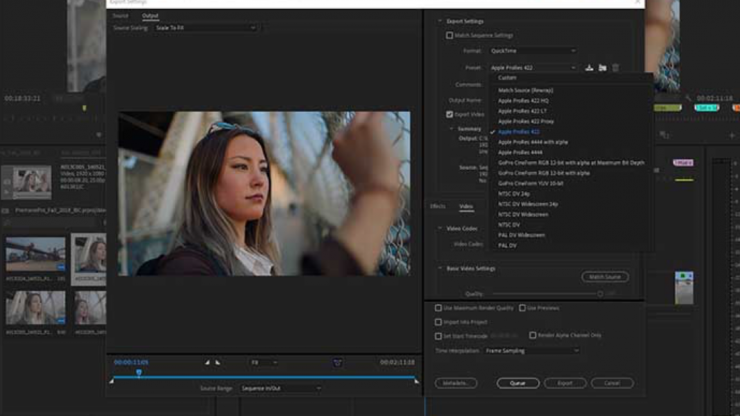
If you are on Mac OS X 10.8, or 10.9, the ProRes codecs come installed with your operating system. If you are using Mac OS X 10.7, you will need to install one of the Apple Pro apps (Final Cut Pro, Motion, Compressor, etc.) for the presets to function correctly. Here’s what’s new with the Media Encoder CC ProRes presets. Quick Info ProRes is an intermediate codec that contains visuals in uncompressed form. This makes it easy for the post-production applications to edit the footages without giving any overhead to the processor or GPU. Once the editing is done, the videos are exported to a distributable, more recognizable format like MP4, MOV, etc. For broadcasting.
- When I'm in Premiere pro, After Effects, or Media Encoder when I export a file to Apple Prores it will not playback on a Windows 10 computer in VLC or Windows Media Player. The only player I could get it to play from was the old QuickTime player. Where can I can a codec that will allow me to playback the prores.mov files? Thanks for your help.
- Download Apple ProApps QuickTime Codecs for Mac to add a pack of codecs to your Final Cut Pro X, Motion 5, or Compressor 4. Apple Intermediate Codec Apple ProRes AVC-Intra DVCPRO HD HDV XDCAM.
- VLC Codec Pack on 32-bit and 64-bit PCs. This download is licensed as freeware for the Windows (32-bit and 64-bit) operating system on a laptop or desktop PC from video codec packs without restrictions. VLC Codec Pack 2.0.5 is available to all software users as a free download for Windows 10 PCs but also without a hitch on Windows 7 and Windows 8.
Apple Prores 422 Codec Download Premiere
ProRes is an excellent codec for editing and finishing. It is 10-bit, which means it provides 1,024 shades of gray or shades of each color per pixel. It has a high bit-rate, which means it retains excellent image resolution. However, there are six versions of ProRes, each of which vary in bit rate (and file size). In order of bit rate and potential image quality, these are:
- ProRes Proxy (smallest file size)
- ProRes 422 LT
- ProRes 422
- ProRes 422 HQ
- ProRes 4444
- ProRes 4444 XQ
Which one is best for your project? Based on my research, conversations and experience, here’s what I recommend.
NOTE: From an audio point of view, all six versions of ProRes have the same excellent, uncompressed audio quality.
[UPDATED] PRORES PROXY
ProRes Proxy is designed to create small file sizes providing very efficient editing. It is not optimized for image quality. ProRes Proxy files CAN be full frame (i.e. the same frame size as the original file). However as implemented by Apple, default proxy files are 1/2 the resolution of the master file to reduce file size. So, a master file of 1920 x 1080, creates a proxy file of 960 x 540.
With FCP X 10.4.9 and later versions, we can now choose proxy files that are 1/2, 1/4 and 1/8 the resolution of the master file using either H.264 or ProRes Proxy codecs. Smaller files have reduced image quality, but are ideal when media needs to be shared between remote editors.
ProRes Proxy is the best choice for:
- Multicam editing with more than four cameras
- Initial editing to reduce storage requirements while the story is still being shaped
- Computers with small or slow hard disks
- Editing where reduced storage or improved performance are more important than image quality
- Sharing files between remote editors
The proxy file resolution may be reduced, but FCP X is designed to display it at the same frame size as the original file. This allows Transform and Cropping effects, among others, to be applied to a proxy file, yet still translate perfectly when switched back to the master file.
NOTE: Here’s a tutorial on the new Final Cut Pro X proxy workflow in version 10.4.9.
PRORES 422 LT
ProRes 422 LT is a format that I don’t use at all. While it has good image quality because it includes every pixel in the image, I find it too hard to create, given how other ProRes options are integrated with Final Cut Pro X.
I definitely don’t recommend setting render files to ProRes LT. Higher bit rate versions are a much better choice.
Prores Codec Download Mac
If I were to archive a standard-definition video project, I’d consider this format. I probably wouldn’t use it, but it would be worth considering. Why consider it? Because ProRes 422 LT generates the smallest file size of all the high-quality ProRes formats.
PRORES 422
This is the default and workhorse video format for all optimized media in Final Cut Pro X. It is an excellent balance between image quality and editing efficiency.
ProRes 422 is the best choice for:
- All 8-bit video formats (including AVCHD, H.264, MPEG-4, DV, DVCPro)
- I would also recommend it for DigiBeta files as well
The trade-off for using ProRes 422 is that the files are large; about 1 GB per minute. However, when I’m editing, I want the best image quality with the fastest performance. I’ll compress the master file down into something smaller for distribution after all the editing is done.
PRORES 422 HQ
This is the best format to use when your camera actually records ProRes 422 HQ. File sizes are bigger, however, about 1.5 GB per minute.
The only difference between ProRes 422 and ProRes 422 HQ is the data rate. And, unless you are using really good lenses with really good lighting, you won’t see a difference between ProRes 422 and 422 HQ.
What you will see is that your hard disks are filling up faster than normal.
PRORES 4444
The difference between the 422 family and the 4444 family is how they deal with color. Image resolution is the same between the two. 422 color sampling creates one color value for every two pixels. 4444 color sampling provides a color sample for each pixel. The 422 family is 10-bit. The 4444 family is 12-bit. More bits equals a more precise range of colors and grayscale values.
The reason you don’t need this higher-quality color sampling for video is that almost all video cameras use 422 color sampling, which means that you don’t improve your color by converting camera images to 4444; you just move it into a larger color space.
ProRes 4444 is the best choice for:
- Video that originates on the computer (screen captures, Motion projects, After Effects projects, Photoshop sequences)
- Video that requires an alpha channel (transparency)
- Video shot by a camera that shoots ProRes 4444, raw, Log, or RGB images
PRORES 4444 XQ
This is the newest member of the ProRes family. It is a very specialized, high-quality format that is designed more for cameras than post.
ProRes 4444 XQ is best for:
- Any camera that shoots ProRes 4444 XQ, such as the Arri Alexa.
If your camera doesn’t shoot ProRes 4444 XQ, converting your files into this format won’t get you anything.
Here’s an article I’ve written that explains this codec in more detail.
SUMMARY
In short, here’s what I recommend:
Prores 4444 Codec Download
- Use ProRex Proxy only for multicam and rough editing, never for output
- Use ProRes 422 for anything you shoot with a camera
- Use ProRes 4444 for anything shot using RGB color space or files that you created on the computer
Prores 422 Codec Download Windows
Following these guidelines can decrease your stress and your hard disk requirements, without damaging your image quality
Bookmark the permalink.